


Junghans J28, updated 04.06.2026
Junghans
Timing Watch
J28 1955 - 1962
628 1962 - 1989
Open face
28, 28/1, 28/2, 28/11, 28/20,
628.00, 628.01, 628.02, 628.11
19'''
48,8 mm
10,0 mm
1/10 sec. = 36000 A/h
1/100 sec. = 360000 A/H
U2340
W1819
400x1,65x15,5x0,21
400x2,4x15,5x0,20
F.W.S 1972 page 111
55 x 76 mm
101g
Kind:
Production:
Type:
Variants:
Size:
Diameter:
Height:
f:
Balance staff:
Stem:
Mainspring:
Reference picture:
Case size:
Weight complete:
The production of the stopwatch began in 1955. In 1962, Junghans decided to rebrand its movements, and the J28 movement was given a new name: 628. Interestingly, a letter dated April 28, 1958, from Friedrich Emmel to Mr. von Zeppelin indicates that the development of the J28 had actually commenced well in advance of that date.
Junghans catalog 1956 text:
Stop Watch 1/10 seconds, with three-circle dial, 7 jewels, jewelled pallets, shockproof, metal case, Start stop and back to zero by successive pressures on the crown, chromium plated metal case 55 mm ø, metal dial.
The 3 advantages of the Junghans Stop Watch 1/10 seconds with Three-circle dial are:
1. Reading made easier by 3 separate dials for minutes, seconds and 1/10 seconds. Avoids hands to be on top of each other.
2. Reading more exactly as the 1/10 seconds hand always stops accurately on the stroke of the scale.
3. Greater exactness as without zero setting fault and without dial fault (no stopping in between strokes)
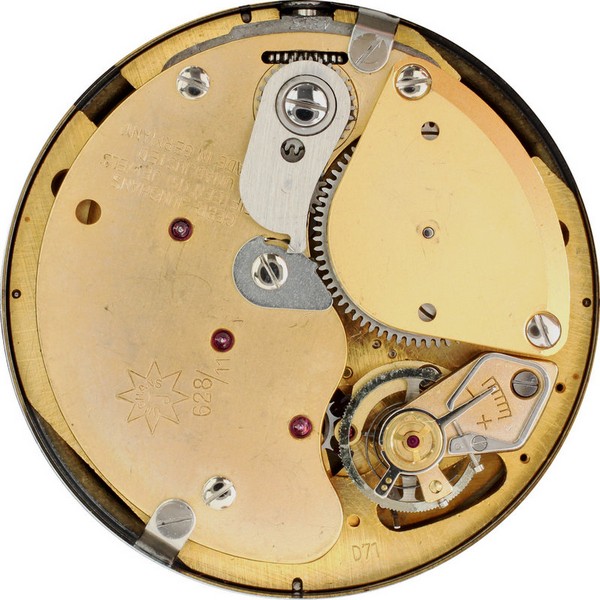
J28/11 1/100 second, 15 jewels, "Meister"
Junghans catalog 1960 text:
Fractions of a Second Decide
The New Triple-Hand Stopwatch Junghans-Meister has been developed to meet practical needs in sports timing. Its accuracy is up to international standards.
Three different figure circles to record minutes, seconds and tenths of a second facilitate reading. Short hands and wide spacing of subdivision markings eliminate incorrect readings. The hand recording tenths of a second always stops on a marking — therefore no ambiguous in-between recordings.
Obtainable from reputable watch and clock retailers in Germany or from factory agents in over 100 countries.
Addresses furnished on request.
Clock and Watch Factories
Gebrüder Junghans A.G.
Schramberg/Black Forest, Western Germany
At the German Athletics Championships in Berlin from July 22nd to 24th, 1960, recordings were made with Junghans Triple-Hand Stopwatches. Manual recordings were verified by the new Junghans automatic recording equipment with photofinish.
Junghans catalog 1983 text:
028/3101
Three-circuit button stopwatch 1/10 second. Chrome-plated metal case with carrying ring. Shock, dust and water protected. 7 jewels.
Movement 628.
028/3111
Three-circuit incrementing sto
watch 1/10 second. Chromeplated metal case with carrying ring.
hock, dust and water protected.
7 jewels. Movement 628.
028/3105
Three-circuit button stopwatch 1/10 second. The same model as 028/3101, but officially certified as suitable for calibration under the number 121/301.
028/3501 Junghans Meister
Three-circuit button stopwatch 1/10 second. Chrome-plated metal case with carrying ring. Shock, dust and water protected. Plates old-plated. 15 jewels. Movement 628.
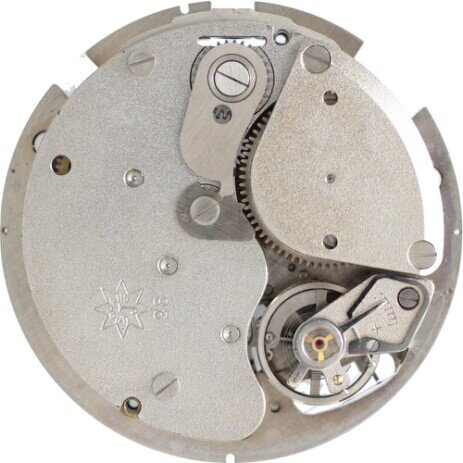
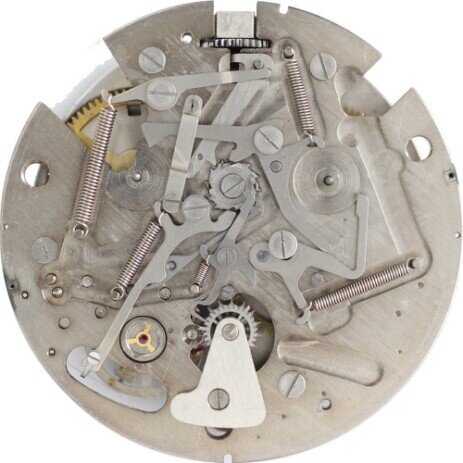
The development of the J28 timing watch movement can be traced back to a significant milestone in 1933 when Hans Schlenker filed a patent, DE597698. In 1935, Junghans was presented with the opportunity to acquire the patent from Hans Schlenker, but they declined. However, in 1937, Hans Schlenker presented an exemplary watch. It wasn't until 1945 when Hans Schlenker joined Junghans as an employee that he became the specialist for timing watches. Finally, after another 10 years of refinement and development, the J28 movement was ready for production. DGC Mitteilungen Nr. 174

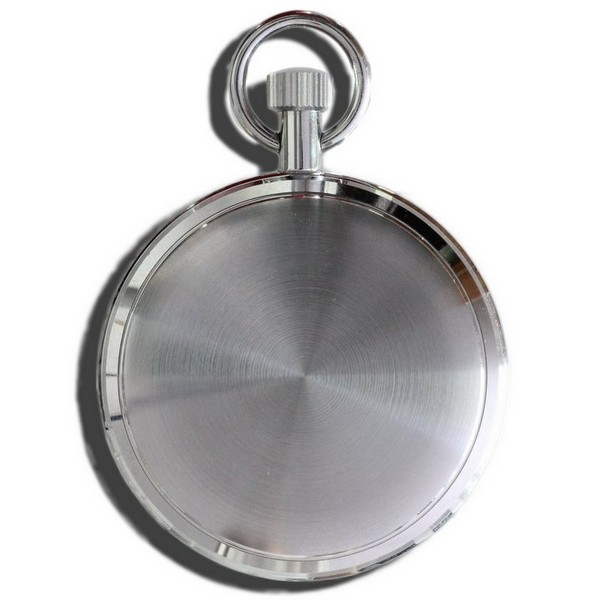
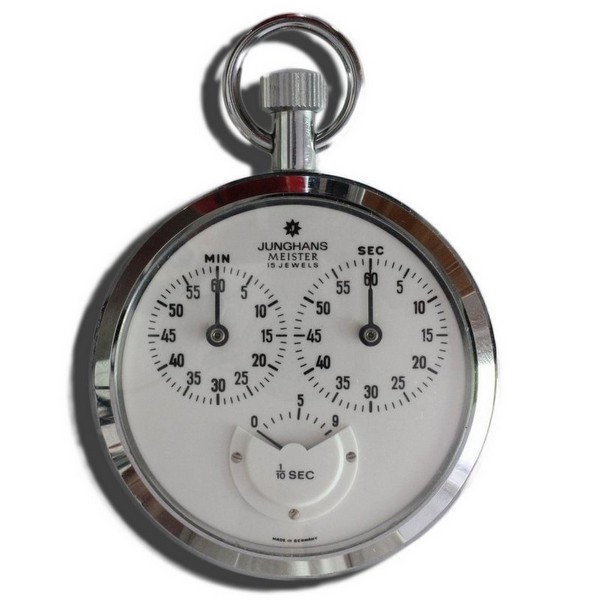
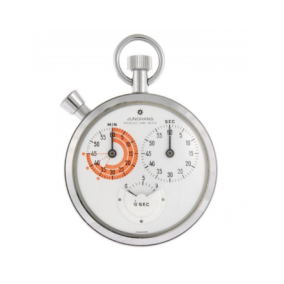

These captivating images below showcasing the Junghans J28/20 "Worktimer" timing watch. Notably, this particular variant of the J28 was conceived by the innovative mind of Hans Schlenker and even secured a patent in the United States in 1960 under the number US3077729. It is fascinating to note that this extraordinary timepiece stands as a unique and exclusive specimen, as it never entered production.
The images below have been graciously provided by Hilmar Bühler.
The images below have been graciously provided by the Deutsches Uhrenmuseum Furtwangen
Extract from the Junghans Stopwatch brochure 1965.
Stopwatch with Three-Circle Dial
Accuracy:
Application:
Movement:
Stopping mechanism:
Case:
Dial:
Maximum recording:
Presentation:
Directions for use:
Advantages:
1/10 sec.
Accurate recording of single processes.
Presision movement with jewelled pallets, 7 or 15 jewels, Balance shockprotected, Nivarox hairspring, antimagentic and independent of temperature variations, barrel with maltese cross stop work, unbreakable mainspring. Balance oscillations are transmitted directly to the 1/10 seconds recording hand, thereby eliminating inaccuracies.
Particularly reliable through hardened steel components and breakproof springs.
Chromium-plated metal case, 55 mm diameter, protected against spray water.
Sprayed white metal dial with three seperate, graduated circles for minutes, seconds and thenth of a second.
60 minutes.
The watch is supplied in a handy artificial leather pouch.
Starting, stopping and return to zero controlled by pressing crown. The stop watch is wound by turning the knurled crown.
Reading made easier by three seperate dials. Hands cannot stop on top of each other. Reading more accurate as reading marks are distinctly spaced and the 1/10 seconds hand always stops exactly on a mark.
Greater accuracy. Each oscillation of the balance is recorded by a distinctly perceptible move of the 1/10 seconds hand. Zero-setting faults and dial faults which influence the timing result are eliminated.
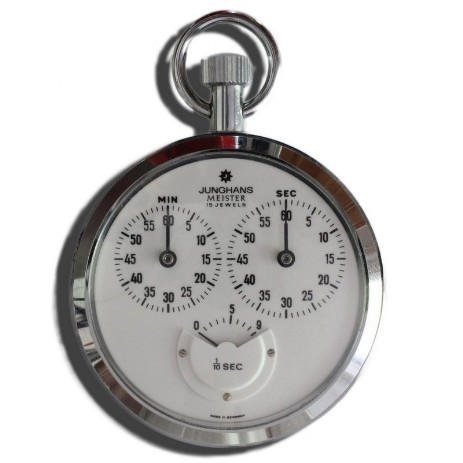
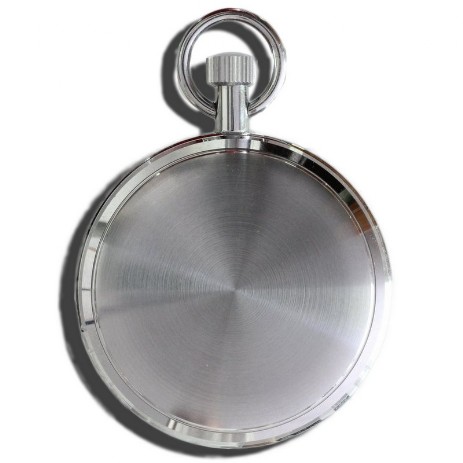
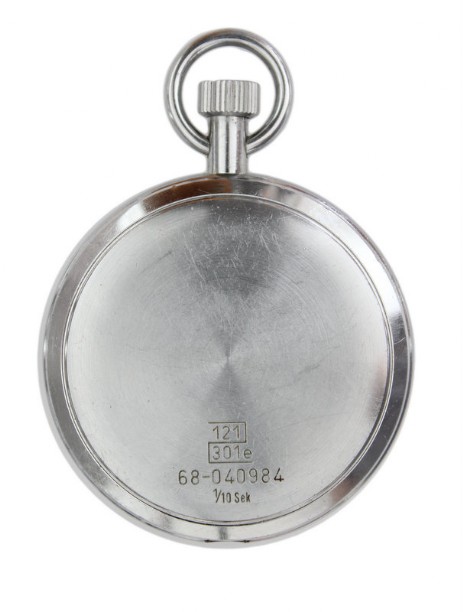
The 1/10 seconds variant with 15 jewels were also available as "Officially tested "Meister" stop watch" with engraved number on the outside of the back. This watch has been tested by the "Physikalisch-Technische Bundesanstalt" and is delivered with a official certificate. Chromium-plated metal case, 55 mm in diameter, spray-water protected, precision jewlled lever movement, 15 jewels, gold-plated plates, shock-resistant, anti-magentic Nivarox balance-spring which is independent of temperature variations, unbreakable mainspring. Construction and performance of the "Meister" stop watch guarantee a timing accuracy which fullfills the requirements demanded by international contest regulations for the recognition of championship records.
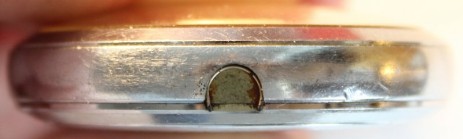
Zulassung von Stoppuhren mit Handtätigung zur Eichung. Amtsblatt PTB Nr. 2/1960 Seite 128.
Junghans J28, 7 Steine, Zulassungsschreiben vom 25.7.1960, PTB Gesch.-Nr. 9270/59 I A/U 3. Ang.
Zulassungsbezeichnung 121 301e
Junghans J28 Meister, 15 Steine, Zulassungsschreiben vom 2.5.1961, PTB Gesch.-Nr. 1946/61 I A/U
Zulassungsbezeichnung 121 302e